Let’s talk some more about the weather disaster in Texas. Or more specifically, about a post by a small-town Texas mayor, who resigned after he went on a rant and it went viral:
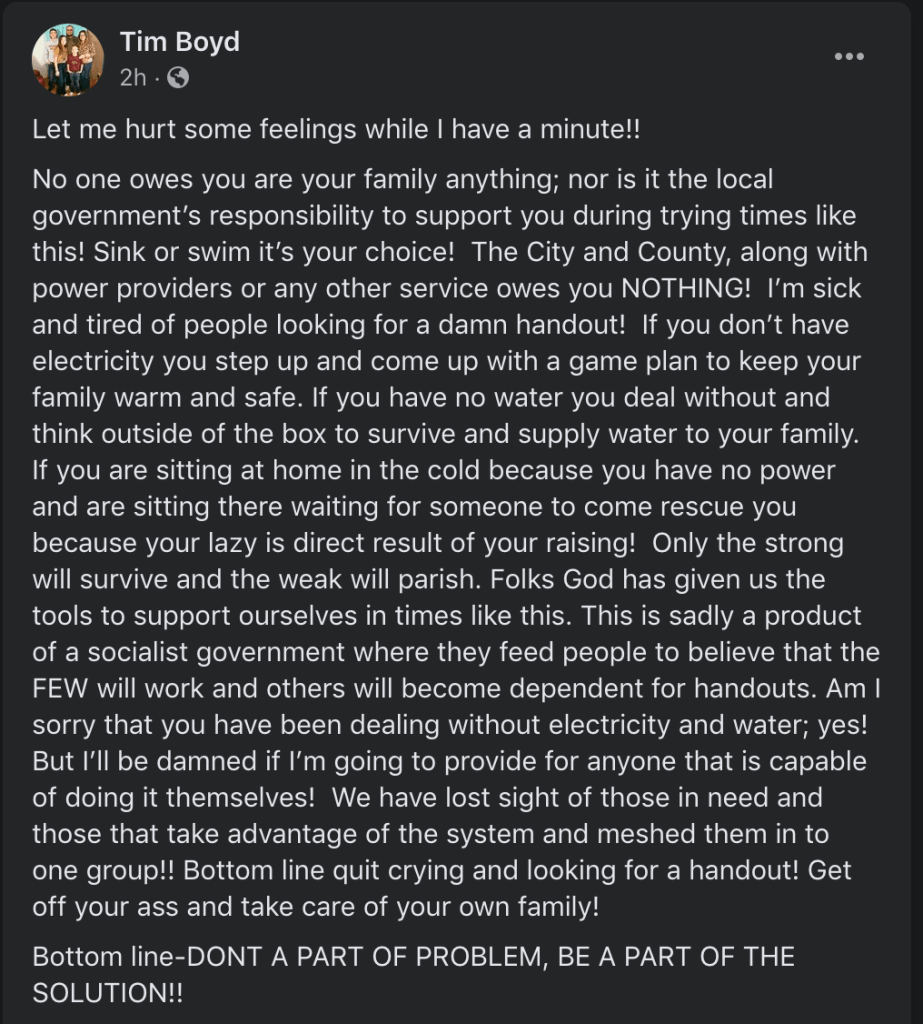
There are some factual problems with his argument. First of all, we already told you that’s not what socialism is.
Second, it’s not true that the “FEW” support the many. Certainly not everyone in the US works: about 60% of Americans over 16 work for pay and about half of Americans pay taxes. But that doesn’t mean the rest are dependent on handouts. About half of those who don’t pay taxes are retirees living on social security they paid into the system while they were working. Non-workers also include students and stay-at-home-parents who are supported voluntarily by other members of their household. In any given month, about 1 in 5 Americans receives a government benefit like welfare or food stamps; the other 4/5 support themselves.
But Boyd’s claim is not about the nature of the welfare state. Rather, he is offering a view of the role of government, namely that government doesn’t owe most people anything…including basic productive goods like electricity and water.
I would say that if his constituents are paying taxes, then the government does, in fact, owe them something. What, exactly, are taxes going to if not government goods and services? There are countries where the government takes revenue from citizens without providing services, but those countries are classified as kleptocracies (“government by thieves”) and we don’t live in one of those (and don’t want to). If the government is going to give you something for your taxes, reliable utilities are not a bad place to start: all wealthy countries provide near-universal access to electrification and clean water and lack of dependable utilities is often one of the most frustrating things about living in a poor or poorly governed country.
I would bet Boyd doesn’t actually mean that people should pay taxes to the government and receive nothing in return. More likely he believes that most people should not receive much government and also should not pay much in taxes. Conservative ideology advocates for lower taxes and smaller government and, regardless of whether you agree with it, it’s a coherent ideology that recognizes the unavoidable trade-off between taxes and services. Boyd appears to be towards the extreme of contemporary conservatism, but as long as he believes taxes and services should both be minimal, there is nothing inconsistent or even particularly unusual in his view of how government should work.
Which then raises the question of why most rich countries don’t govern the way Boyd would prefer. Why do all wealthy countries choose to tax their populations and regulate utilities, instead of letting people keep their money and prepare for emergencies as they see fit?
The main reason is that most wealthy countries are democracies, which means that government will do, broadly, what the population wants it to. There is nothing inherently more correct about a government that regulates utilities than a government that doesn’t. But most people prefer to have a government that will guarantee the electric and water supply. Why? There are any number of reasons. Possibly people just don’t like the thought of trying to run a business when they can’t be sure the lights will turn on. Possibly they’ve calculated that it’s cheaper to have a reliable electric grid than millions of private generators. Maybe they prefer the frequent-but-predictable cost of taxes to the rare-but-unpredictable costs of surges and blackouts. Or maybe, as Boyd suggests, they’re lazy and would rather take a handout than spend some effort looking after themselves.
But it doesn’t really matter why people prefer what they prefer. A government doesn’t just legislate itself into being. It’s created by society to solve the problems that they can’t or don’t want to solve themselves. What those problems are, and how they should be solved, is up to society. There is no correct or appropriate role for government beyond what society decides government’s role should be. That’s why countries like the US and Finland and Korea can implement policies from different places on the ideological spectrum and still be considered well-governed. Of course all policies have costs and benefits, but as long as the citizenry is willing to pay the costs of whatever they ask government to do – whether that’s utilities, handouts or something else – then tada! Doing that is now the role of government.
So does that mean Mr. Boyd is wrong about what government is for? Of course not. There is no objectively correct answer and he’s as entitled to his ideas about governance as anyone else is. But he also doesn’t get to decide unilaterally what government means…and in this case he appears to have been outvoted.

 Wait! We can explain!