Cancelling Coke; cancelling votes

Major League Baseball has moved the league’s all-star game from Georgia to Colorado to protest a restrictive voting law passed by the Republican-dominated Georgia state legislature. Coca Cola and Delta airlines, both headquartered in Georgia, have also criticized the law. Some people – including President Biden – are happy companies are speaking up. Other people are pretty offended and are calling for boycotts of baseball and Coke. Americans cancelling baseball??? And COKE??!? That’s a pretty big deal. But then again, so is the law.

The law makes a few changes that make voting easier, for example requiring early voting on at least two weekend dates and providing at least one ballot drop box in every county. But it includes a number of provisions that would make voting harder: voters must have a reason to receive an absentee ballot and county officials are forbidden from sending mail-in ballots to all voters. The window for requesting an absentee ballot is shorter, the number of ballot drop boxes a county can provide is capped, and somewhat bizarrely, there is now a ban on delivering food and water to voters waiting in line.  

These provisions are likely to reduce turnout. Evidence indicates that universal mail-in ballots – which are now explicitly banned in Georgia – increase the number of people who cast a vote. Turnout is also lower where voters have had a bad experience waiting in long lines in prior elections. A law that makes waiting in line extra miserable by ensuring that voters also can’t get access to food or water while they’re waiting increases the chance that they will walk away not only from that election, but also later ones.

More importantly, the law also gives an electoral advantage to one party and it happens to be the party that wrote the bill. When turnout is low — including for completely innocuous reasons like bad weather — it often (though not always) advantages Republicans. This is because some people face more obstacles to voting than others, and any additional obstacles can be the final straw that keeps them home. Citizens who struggle to get to the polls are disproportionately younger, lower income, and non-white. In general, laws that place restrictions on voting disproportionately reduce turnout among these groups….and members of these groups more likely to be Democrats.

Additionally, the particular rules the Georgia legislature included in the bill systematically and specifically make voting harder for urban voters and voters of color (read: Democratic voters). The news rules about ballot drop boxes, for example, would ensure there is now a box in rural counties that didn’t have one before, but would reduce the number of drop boxes available in cities. The ban on food and water only matters for people waiting in long lines, but long lines occur disproportionately in urban areas and in areas where most voters are not white.

Given the likely effects, is there there some other legitimate purpose that these laws could serve? Was the Georgia state legislature really trying to pass a law for the purpose of discouraging turnout and advantaging themselves? Unfortunately, it seems that way. Voting restrictions like the ones in the law are typically justified in terms of preventing voter fraud. But there is not any evidence of meaningful fraud in US elections. If people were impersonating others or casting fake ballots in large numbers, we would be able to detect it in existing, public turnout records. Nevertheless, despite a lot of effort by a lot of people trying find voter fraud, no one has been able to find much.

Ballot harvesting, where people “help” others fill out their ballots at home or even collect blank ballots and them out on voters’ behalf is easier with mail ballots, but it is also hard to do at large scale without eventually getting turned in by voters who would really prefer to fill out their own ballots, thanks. Even with the extensive mail-in voting of the 2020 election, arrests for fraud involving more than a ballot or two have remained exceedingly rare. Preventing fraud, while a reasonable goal in theory, is not necessary in practice. Any additional fraudulent votes the Georgia law might prevent would almost certainly be outweighed by the number of non-fraudulent votes it would also prevent.

In fairness, lots of countries have laws like the one in Georgia….but we generally don’t classify those countries as democracies. In another country, passage of a law like this would alarm the international community, reduce a country’s democracy score, and likely be classified as a “democratic rollback“. Imagine if you learned that, say, Cambodia was forcing people in opposition districts to wait in long lines with no access to food or water just to cast a ballot. Or if the Ugandan legislature reduced the number of places to drop a ballot, but only in regions of the country where people were likely to vote against them. You would likely think that was both undemocratic and a fairly easy ploy to see through. And you would be correct. Even if you support the Republicans and would prefer they win elections, it is important to recognize that this particular method of winning is not compatible with democracy.
Are you being censored?

Right now there is a lot of talk about censorship. And as usual when people talk about censorship, a lot of it is wrong.

Like socialism, “censorship” has a particular meaning in political science. It doesn’t mean that someone feels they can’t say something unpopular for fear of negative consequences (consider that in many contexts, holding your tongue to avoid trouble is simply called “being polite.”) Censorship refers specifically to government action to prevent the dissemination of certain information or ideas, typically information that threatens the government. Censorship can take many forms, including redacting documents, regulating media content, or jailing publishers. But for something to be censorship – and especially censorship that represents an unconstitutional violation of free speech — it has to be enforced, directly or indirectly, by the government.

Most people are against government censorship, and for good reason. You don’t want your government in the habit of restricting the flow of information, because information is what allows people to control their governments.

Government is more likely to act in the public interest when politicians know they can lose their job if they don’t. But citizens will have a hard time knowing who to act against if they don’t know what their politicians are doing in office; free information helps to solve that problem. In Brazil, for example, municipal leaders’ vote share went down when audits were released showing multiple irregularities in their use of funds; the effect was strongest in areas with local radio stations. In the US, scandals reduce legislators’ vote share and increase campaign scrambling, but only for scandals that attract national media coverage. Where media is censored, the government can avoid accountability and maximize their chance of holding onto power by banning the dissemination of damaging information.

Information is also one of the best ways to solve the collection action problem. Once citizens know that their politician isn’t performing to standard, they have to work together to remove him: one person voting or protesting isn’t going to do much. But getting enough people to show up at the same time requires communication. Governments know this, which is why the Chinese government uses its thousands of censors to remove, not criticism of the government, but information about events or meetings that might allow people to coordinate action against the government. Many repressive regimes entirely black out the media during elections, protests and other events during which the citizenry might organize; one explanation for the success of Arab Spring was that protestors were able to get information from satellite internet and television stations that were not under the control of repressive governments.

All this said, we don’t have meaningful censorship in the US. Our government does not (currently) throw people in jail or close down media outlets for their speech. In fact, our judicial system actively protects the right of citizens to speak against the government. Cease and desist orders from politicians are legally toothless. Standards for finding libel or defamation against elected officials are very hard to meet. Government employees, in most cases, can’t be fired for what they say off the clock. The government can impose what are called “time manner place restrictions”, which means that, as long you have other outlets for your speech and you aren’t being punished for what you are saying, the government can ban you from engaging in speech in certain ways…such as by texting while driving down the highway at 80 mph. This is also not censorship: you are free to criticize the government without punishment, as long you take the simple step of pulling off the road first.  

In short, if the consequences of your speech don’t come from government – no matter how unpleasant those consequences may be – they are not censorship. Afraid you’ll be fired from your retail job if you speak out against the company online? Maybe that’s not fair, but it’s also not censorship. People refusing to shop at your business because they don’t like the things you say on social media? That’s not censorship either. Newspaper didn’t publish your letter to the editor? Classmates ask you to stop using terms they find offensive? An author’s estate decides not to publish some of his books anymore? Nope, nope and DEFINITELY nope. None of those are censorship. And because the right to free speech protects you from government censorship, none of these consequences are violations of your right to free speech either.

Of course, if you want to persist in calling these things censorship, you can. The government certainly won’t stop you.

No one should be surprised the royal family is racist

On March 7th, Harry Windsor and Meghan Markle, former British royals, sat down for a tell-all interview with Oprah Winfrey. The interview raises a lot of questions. Why did Prince Charles stop taking Harry’s calls? Why is “working royal” a job that a person can have in 2021? Why did Oprah pick those glasses in particular?

One question we shouldn’t be asking, though, is whether Meghan really encountered racism at the palace. Irrespective of whether or how particular events occurred, it would have been almost impossible for her not to encounter racism. Even absent anything we know about the royals as individuals, or about the British monarchy as an institution, the social science literature is unequivocal that racism is incredibly common.[1]

Precisely measuring racism is difficult, due to something called social desirability bias: it is not polite to be racist, so if you ask someone outright if they dislike or disrespect people of other races, they might not tell you the truth. If fact, they might not know or admit their racism to themselves.

But social scientists have developed some ways to get around this problem. One approach is a list experiment. In this type of experiment, half of subjects are given a list of four or so innocuous statements (e.g. “I prefer to get my news from the radio”). The remaining subjects are given these same four statements plus an additional, more contentious statement (“I prefer to vote for someone of my own race.”) Subjects then report how many of the statements they agree with, but not which ones, meaning they can agree with the contentious statement without directly saying they agree with it. However, by calculating the average number of “agreements” in each group, and taking the difference, we can estimate how many people in the second group agreed with the contentious statement. This approach is how we learned that at least 42% of white people in the southern US were “angry” at thought of a Black family moving in next door and that only half of Irish people are comfortable with the idea of Black or Muslim people immigrating to Ireland.

Another option is an implicit association test (IAT), which captures evidence of bias before subjects can consciously notice and censor that bias. The test asks subjects to sort images and words to one side of the computer screen or the other, as quickly and accurately as they can. Subjects might be asked, for example, to sort images of Black people and words with positive meaning to the left side of the screen, and images of white people and negative words to the right. Then the words and images would switch, to match Black people with negative words and white with positive. The premise of the study is that if someone is biased against Black people, it will take them a split-second longer to remember to sort the images of Black people into a bin with positive words than to sort them into a bin with negative words. The computer captures this tiny delay and translates it into a measure of bias. The IAT shows that the average person has measurable pro-white bias in the US as well as in Europe  

To be entirely clear, neither list experiments or IATs are perfectly reliable, and both can be misused or misinterpreted. But in truth we may not actually need them: a surprisingly high number of people are willing to admit their racism without much sneakiness at all. On the 2012 American Election National Survey, for example, 34% of respondents rated Black people’s average intelligence lower than they rated white people’s; 43% rated Black people as less hardworking. A similar number of Brits (44%) report that “some races” are born harder working than others.

So now what? If racism and bias are that common, does that mean we can stop worrying about them? Surely if everyone is racist, being racist isn’t really a problem, right?   

Unfortunately, wrong. Racism does tangible harm, whether it’s intentional or not. Racism in employers means that applications with stereotypically Black names at the top are less likely to result in an interview than identical applications with white names, and both Black and Asian job-seekers are more likely to get an interview if they disguise their race on their resume. Racism in teachers means that children of color are more likely to be suspended and less likely to score well on standardized tests. Racism in medicine means that Black newborns in the US are twice as likely to die when they are cared for by white doctor than a Black one. And not many people in 2021 need to be told about racial disparities in use of force by police.

Besides, even if you have subconscious bias, you can become aware of your bias and prevent it from affecting your words or behavior: if people couldn’t control their racism, we wouldn’t need to worry about things like social desirability bias. So stop trying to figure out if you’re racist — you probably are! — and instead learn what harmful words and behaviors look like, sound like and feel like. And then stop doing those things too.


[1] There is some debate over what, exactly, racism is, and social scientists don’t always define it the way the general public does. For purposes of this post, racism is defined as a belief (conscious or otherwise) that people who are not white are different from, and in some way inferior to, white people.

Minimum wage and the policy prediction problem

One of the biggest news stories at the moment is an attempt by House Democrats to raise the federal minimum wage to $15/hour. This is almost double the current minimum wage of $7.25/hour, which was last raised in 2009.

So what will happen if the bill passes? Will the economy grow? Will people be fired? Will there be inflation? Will minimum-wage workers be better off? Will society as a whole be better off?

I would probably have a better answer for you if I were a macroeconomist. But the bad news is there probably isn’t way to say for sure. The impacts of any economic (or non-economic) policy are difficult to determine in advance. That’s because there are a lot of moving parts in an economy. And the moving parts are interconnected, like gears in a machine – anything that moves one part moves another and that moving part might cause the first one to speed up, slow down, or entirely change direction. Except that these moving parts are people, not gears, and people are a lot less predictable than gears are.

To give a simple example (that will quickly stop being simple): let’s say minimum-wage workers whose income increases spend some of that income on groceries. Grocers, realizing that more people have more money to spend, might raise their prices. But if a grocer raises his prices, he might lose customers to another grocer….unless other grocers also raise prices, which they might…unless they think they’ll be more competitive if they don’t, which they might be…unless they fire workers to keep their prices low, and people don’t want to shop in an understaffed store when they can afford to shop somewhere else….unless they can’t afford that, because $15/hour doesn’t go that far when all the grocers raised their prices.

Sorry…where were we?  

The point is that how the gears people will ultimately settle down into their new patterns is very hard to figure out theoretically. For one, once you’ve set up the math to account for all those feedback loops, it might take a supercomputer a few days to run those calculations for you. But the accuracy of your prediction also depends on how well you identified everyone who would be affected by your policy and how they would respond.  One wrong assumption and your whole prediction will be off, no matter how fancy the math. That’s why there can be (and is!) so much disagreement about how a policy will turn out, even among smart people who are doing rigorous work.

That means we are often left with…just trying a policy to see what happens. The good news is that new policies usually start as pilot programs in cities or states and are adopted more widely if they have the desired effects. But even this isn’t perfect. Policy is often (though not always) endogenous, or chosen by the people who put it in place. And people choose a policy when they think it will solve whatever problem they are trying to solve. To the extent that there is something about pilot communities that made the policy particularly effective or appropriate there, the policy may have different effects once it’s implemented elsewhere.

That’s why, even though cities like San Francisco and New York have had positive experiences with raising minimum wage, we can’t entirely rely on these examples to predict how a national wage hike would go. For starters, both cities have remarkably high cost of living; elsewhere, wage hikes might more dramatically increase consumption. California and New York also have relatively robust safety nets in place for low-income residents – including rent control – which might affect how much costs change (or don’t) in response to a widespread increase in private income.

None of this is to suggest that increasing the minimum wage would be a bad idea. We can’t entirely predict what a $15/hour minimum wage will do, but that’s as true for those who are predicting bad outcomes as it is for those who are predicting good ones. Not implementing a policy also has risks and costs. So what can we do? At a certain point, once we’ve gathered the best evidence we can, we simply have to fall back on our values. What outcomes do we care about and how much do they matter to us? Does the potential for achieving them outweigh the risks of implementing a policy that is ineffective….or even harmful? Ideology comes into play here. So does acceptance of risk. And so does careful policy design that includes safeguards and a plan for a worst case scenario.

If you support the $15/hour wage and you’re frustrated about the pace of change, that’s entirely reasonable, and reflects how you have balanced the risks and benefits. But remember that those who have pushed back against the policy and slowed the pace are not necessarily trying to undermine wage hikes or minimum-wage workers. They may have simply struck a different balance in the presence of uncertainty…and that’s reasonable too.

Mayor Boyd and what government is for

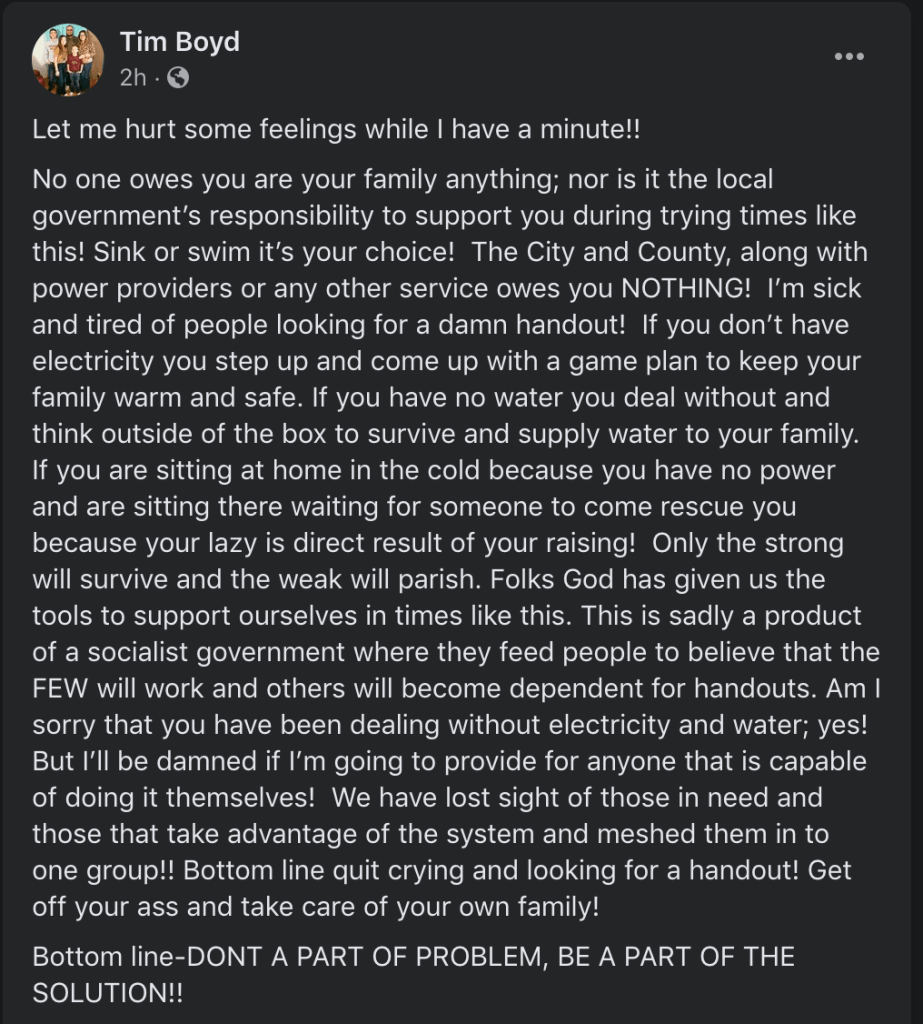
Let’s talk some more about the weather disaster in Texas. Or more specifically, about a post by a small-town Texas mayor, who resigned after he went on a rant and it went viral:

There are some factual problems with his argument. First of all, we already told you that’s not what socialism is.

Second, it’s not true that the “FEW” support the many. Certainly not everyone in the US works: about 60% of Americans over 16 work for pay and about half of Americans pay taxes. But that doesn’t mean the rest are dependent on handouts. About half of those who don’t pay taxes are retirees living on social security they paid into the system while they were working. Non-workers also include students and stay-at-home-parents who are supported voluntarily by other members of their household. In any given month, about 1 in 5 Americans receives a government benefit like welfare or food stamps; the other 4/5 support themselves.

But Boyd’s claim is not about the nature of the welfare state. Rather, he is offering a view of the role of government, namely that government doesn’t owe most people anything…including basic productive goods like electricity and water.

I would say that if his constituents are paying taxes, then the government does, in fact, owe them something. What, exactly, are taxes going to if not government goods and services? There are countries where the government takes revenue from citizens without providing services, but those countries are classified as kleptocracies (“government by thieves”) and we don’t live in one of those (and don’t want to). If the government is going to give you something for your taxes, reliable utilities are not a bad place to start: all wealthy countries provide near-universal access to electrification and clean water and lack of dependable utilities is often one of the most frustrating things about living in a poor or poorly governed country.   

I would bet Boyd doesn’t actually mean that people should pay taxes to the government and receive nothing in return. More likely he believes that most people should not receive much government and also should not pay much in taxes. Conservative ideology advocates for lower taxes and smaller government and, regardless of whether you agree with it, it’s a coherent ideology that recognizes the unavoidable trade-off between taxes and services. Boyd appears to be towards the extreme of contemporary conservatism, but as long as he believes taxes and services should both be minimal, there is nothing inconsistent or even particularly unusual in his view of how government should work.

Which then raises the question of why most rich countries don’t govern the way Boyd would prefer. Why do all wealthy countries choose to tax their populations and regulate utilities, instead of letting people keep their money and prepare for emergencies as they see fit?

The main reason is that most wealthy countries are democracies, which means that government will do, broadly, what the population wants it to. There is nothing inherently more correct about a government that regulates utilities than a government that doesn’t. But most people prefer to have a government that will guarantee the electric and water supply. Why? There are any number of reasons. Possibly people just don’t like the thought of trying to run a business when they can’t be sure the lights will turn on. Possibly they’ve calculated that it’s cheaper to have a reliable electric grid than millions of private generators. Maybe they prefer the frequent-but-predictable cost of taxes to the rare-but-unpredictable costs of surges and blackouts. Or maybe, as Boyd suggests, they’re lazy and would rather take a handout than spend some effort looking after themselves.

But it doesn’t really matter why people prefer what they prefer. A government doesn’t just legislate itself into being. It’s created by society to solve the problems that they can’t or don’t want to solve themselves. What those problems are, and how they should be solved, is up to society. There is no correct or appropriate role for government beyond what society decides government’s role should be. That’s why countries like the US and Finland and Korea can implement policies from different places on the ideological spectrum and still be considered well-governed. Of course all policies have costs and benefits, but as long as the citizenry is willing to pay the costs of whatever they ask government to do – whether that’s utilities, handouts or something else – then tada! Doing that is now the role of government.

So does that mean Mr. Boyd is wrong about what government is for? Of course not. There is no objectively correct answer and he’s as entitled to his ideas about governance as anyone else is. But he also doesn’t get to decide unilaterally what government means…and in this case he appears to have been outvoted.

When Texas freezes over

If you live in Texas, or know someone who does, you know that right now the state is experiencing a massive – and bizarre – cold front. Though the average low temperature in February in Texas is 36°F, some parts of the state now have temperatures below zero. The cold has overwhelmed the state’s infrastructure: water pipes are freezing, electricity turbines are freezing, the power grid can’t keep up. People are getting dangerously cold in poorly-insulated homes with no heat, no hot water and no ready supply of winter gear like most of us have up here in the tundra. (Yes, I know North Dakota is not actually the tundra.)

How did this happen? Why didn’t Texas have a system in place to keep people from freezing to death? Why wasn’t everything insulated? Why didn’t they have alternative power supply?

We might also ask the same about lack of preparedness for major hurricanes, landslides, tsunamis and (ahem!) pandemics. As it happens, most governments, most places, under-spend on preventing damage from rare but catastrophic natural events. A lot of damage from natural disasters could have been prevented, but wasn’t. Why not?

To start, disaster prevention is expensive and when you are trying to prepare for a very rare event, it doesn’t always make sense to spend the money. Every dollar spent on preparing for a disaster that might or might not happen is a dollar not spent on something else that is needed right now, like teachers’ salaries or unemployment insurance or road repairs. Temperatures like these don’t happen in Texas often: the last similar cold snap happened roughly 30 years ago. Asking why Texas wasn’t prepared for sub-zero temperatures is a bit like asking why I haven’t paid to have my little house on the prairie retrofitted to survive an earthquake. (Of course my house is designed to prevent flood damage, but floods in Fargo are common, not rare).

But that’s not all there is to it. As it turns out, politicians don’t have a strong incentive to put a lot of money into disaster prevention. One problem is time horizons. Disaster prevention means spending money now, to reap a reward at some later date, when disaster strikes. However, most of the people involved in disaster preparation are in the executive branch —  presidents, governors, mayors – and these politicians typically serve only a few terms. Chances are good that the politician who makes the sacrifices necessary for disaster prevention (which means reducing other expenditure or increasing taxes) will be out of office before the disaster shows up. Most politicians are not excited about bearing all the expense of investment so the next person can get all the benefit. (Imagine if she not only gets all the credit, but she’s from the other party! That would be a real disaster!)

The other problem is visibility. Disaster prevention is not particularly easy for voters to see and understand (have you read your state’s disaster plans?) Plus voters may dismiss the need for prevention because humans are notoriously terrible at estimating the risk posed by rare events. Disaster response, on the other hand, is highly visible. The disaster is no longer hypothetical and voters can directly observe whether and how quickly their government comes through with housing, food relief and insurance payments. And they reward politicians who respond in the wake of disaster in exactly the way they don’t reward politicians for effective disaster prevention, because no one pays attention to disaster prevention. So not only do politicians have little incentive to prevent rare disasters, they have something of an incentive not to prevent them. If disaster happens to strike, they can swoop in and save the day.

As usual for this blog, if you don’t like it, do something! Learn about disaster prevention and start rewarding politicians for their plans, rather than their response. If voters demand preparation, politicians will prepare. And otherwise, Texans will just have to be really really cold every 30 years or so. Holler if you need us to send you some mittens, y’all!

Puzzled about the impeachment vote? Yeah, that’s politics. Sorry.

Donald Trump was tried by the Senate last week for impeachment on the charge of inciting the deadly insurrection at the Capitol on January 6th. He was acquitted: though a majority of Senators (57 to be precise) voted against Trump, this falls short of the two-thirds majority (67 votes) that would be required to convict.  

The impeachment was historic for a number of reasons. It was the first time that a president was tried for impeachment twice. Additionally, though members of the president’s party typically don’t vote to convict, seven Republicans voted to convict Trump.

What explains why some Republicans voted to convict? And what explains why most Republicans voted to acquit in the face of what many people – especially people in the Democratic party — believe was overwhelming evidence?

I don’t have a definite answer for either question. Aren’t you glad you stopped by?  

But, in general, when trying to explain why politicians are doing something we don’t like, it’s helpful to remember that politicians have many people they are trying to please in order to keep their jobs. (In the jargon of political science we say they have multiple principals). Individual senators have their own beliefs and preferences. But the US is a democracy, which means that senators have to keep their voters happy, or at least happy enough to be reelected in the next cycle.  It’s hard to represent your constituents if they vote you out of Congress.

Senators also have to keep the other members of their party happy. If they don’t, the party might not nominate or endorse them in the next election, or promote them to leadership positions within the party. And senators need to consider something called log-rolling, which is a back-scratching type of deal where someone supports your legislative priorities in exchange for your support of theirs. Senators who don’t cooperate with other legislators won’t be able to call on their colleagues to back legislation that would benefits their constituents.

In short, a legislative vote is rarely as simple as a senator listening to debate and making a choice. Regardless of how any senator voted, their vote almost certainly reflects cross-pressure from a number of sources. And in most cases, that pressure is a good thing: think about your reaction if you voted in a senator from your party and then she just did whatever she wanted, irrespective of what constituents or the party thought was best.

I would guess most senators’ votes on impeachment reflect how their constituents and party wanted them to vote.

So what did senators really think about the impeachment? We can get some insight from the Republicans who broke with their party. Almost all of them were either retiring or won’t be up for reelection until 2026. If these senators need to worry about reelection at all, they can safely assume both voters and the party will have forgotten about their impeachment vote by 2026. This pattern suggests that much of the pressure to acquit Trump was coming from voters and the rest of the party, and when freed from these pressures, they voted their personal preference to convict.

On the other hand, these who voted to acquit are not the only Republican senators who aren’t up for reelection. Many other senators, including one senator who is retiring, voted to acquit. These senators weren’t necessarily pressured into their votes: they heard the evidence and decided acquittal was the right choice.

Don’t like it? Unfortunately, having politicians who disagree with us is an inherent part of democracy: the only way to ensure that everyone does things our way is to have an autocracy (and be the autocrat). If senators from other states cast votes you don’t agree with, there’s not a whole lot you can do: they don’t represent you and your poor opinion of them doesn’t affect their ability to do their job. However, if your own senator voted differently than you would prefer, or your senator shares a party with a senator whose vote you dislike, devote some time or money to political action. You can become part of the pressure that might make a vote to come out differently.

Collective action and the GameStop Gambit

Recent news has been abuzz with a store that had its heyday a decade ago: GameStop. Not because of the store itself, but for the fact that thousands of people on Reddit decided that GameStop would serve as their stand against Wall Street.

GameStop’s stock value is declining and hedge funds were short-selling it. That means they were borrowing stock in GameStop with a promise to return it at a later date. While they were borrowing it, they sold it to other people at current market prices. They planned to buy the stocks back later, once the price had fallen further. Then they would return the stock they borrowed and pocket a tidy profit. Or that was plan anyway. What happened instead is that buyers descended on the market, purchasing stock in GameStop and driving up the price. Now all the hedge funds that had shorted the stock had to buy it back at a price far, far higher than they sold it for. So much GameStop stock was involved that losses to the hedge funds tally in the billions of dollars.

The GameStop Gambit™ was notable not only because of its effects, but because…it worked. GameStop buyers spent their own money – up to $300 a share – to buy essentially worthless stock. And just a few buyers wouldn’t have moved the price: to work, the gambit had to involve thousands of people.

A large amount of research indicates that humans, as a group, are willing to take on substantial personal cost to punish others who are behaving in ways that seem harmful or unfair. And Wall Street is certainly a likely target: surveys show that a majority of Americans believe Wall Street does more harm than good and there is consistent public support for additional measures to “hold Wall Street accountable”  

Even people’s willingness to punish, however, has limits. No matter how much they hated Wall Street, every buyer in this scenario had an incentive to wait and see if other people were going to buy; then they would get the satisfaction of seeing the hedge funds punished without having to spend any money. This is the collective action problem and it’s a problem that’s hard to solve: when everyone sits there hoping someone else will contribute, no one contributes, and whatever they group was trying to accomplish doesn’t get accomplished.

Of course, in the case of the GameStop Gambit™, the collection action problem was solved. Regardless of how you feel about the gambit, you should be impressed that they managed to pull it off. Hooray for the little guys! What can’t people do when they work together!  

But it is doubtful that collective action would be able to control Wall Street over the long run. Bringing down every hedge fund in the US would require sustained attention, effort, and quite a bit of money. Most people don’t hate Wall Street enough to keep investing at GameStop levels, especially if other people stop contributing as well.

So what should GameStop sympathizers do about the collective action problem? Throughout history, most societies have solved the problem with government. A well-functioning government solves most collective action problems by making them unnecessary. Government gathers collective resources and uses them to enforce desired outcomes, so the citizenry don’t have to keep showing up en masse to make things happen. If we want it to, our government has the means to regulate Wall Street to prevent the sorts of outcomes that are making people angry. Then the big guy would be taken out by the even bigger guy and the little guys could stop worrying about it and go back to Redditing.

For those who are cheering on the GameStop Gambit, consider organizing instead to demand regulation. It’s a far more permanent solution…and you won’t end up with a bunch of stock in GameStop.

Socialism: Not meaning what you think since 1867

Happy inauguration! Did you see the fireworks? Weren’t they pretty?

More importantly, now that Joe Biden has been sworn in, and the Democrats control both houses, is the US about to become a socialist country?

Though it is fairly common in American political discourse for people to use the word “socialism” to describe any policy to the left of what they would prefer – or, occasionally, to describe a policy they just don’t like – “socialism” has a specific meaning, and neither Biden nor the Democratic party have socialism in their platform.

Socialism is an economic system; the contrasting system is capitalism. In a capitalist system, like the one we have in the US, almost all goods are produced by privately-owned firms who set their own production targets and prices. Any firm can choose to make and sell a good, and whether they succeed depends on customers’ demand for the good and competition from other firms.

In a socialist setting, there are no privately owned firms. The population, or, more likely, the government that represents them, decides what goods are to be made and what collective resources (including money, land and labor) will be used to make them. Fees and surplus go back into collective accounts to fund more provision of goods and services, rather than becoming private profit to firms.

The difference between the systems is in whether firms are owned by private citizens or the government. Though socialist systems require government regulation, regulation is not socialism. Just as a functioning democracy can prohibit certain personal behaviors like theft and assault, a functioning capitalist system can prohibit certain firm behaviors like fraud or dumping. Taxes are also not socialism. All governments — socialist or otherwise — tax their populations in order to provide necessary public services that private firms won’t, like highways, national defense, and the law enforcement.

Democrats typically support increased taxation and regulation. However, they don’t advocate taking firms from private citizens and giving them to the government to run. Therefore, they are not proposing socialism.

But what about Medicare for All? Many Democrats want that. Isn’t that socialized medicine? Not really, no. In other countries, where the government owns hospitals, hires doctors and purchases medication, government healthcare could be called socialized (though socializing healthcare would not make the entire economy socialist.) But Democrats don’t want the US government to take over the provision of health care. MFA, and the current Medicare and Medicaid programs, are more appropriately labeled single-payer systems, where the government pays for services from private doctors and hospitals: the government under MFA is a customer, not a producer. Therefore – once again – there is no socialism here.

Regardless of whatever policies a party might propose, any system where citizens are free to form corporations, own businesses, sell goods and put profits into their own bank accounts is a capitalist system, not a socialist one. I do not expect the US to become socialist in my lifetime or yours, no matter who is president.

Why was there violence?

No matter what you want to call the events at the capitol on Jan 6, they were undoubtedly violent – towards property and people — and the violence was intended to serve a political goal: registering discontent, frightening lawmakers into voting as the rioters wanted, or, more extremely, overturning the election and keeping President Trump in office.  

Political violence is (thankfully) not currently the norm in the US, but the violence at the Capitol was not particularly surprising based on what we know about when political violence happens. Most generally, violence happens when people feel they can’t get the outcomes they want or need by using formal or legal methods.

One key trigger of political violence is perceived electoral fraud; fraud undermines elections, which are the primary non-violent channel for influencing political outcomes. In Nigeria, where political violence is unfortunately fairly common, perceptions of fraud are more important than actual fraud in predicting whether individuals will turn to violence. The Capitol rioters almost certainly believed the election was fraudulent: Trump and his allies in government and media worked before the election and after to convince supporters that the election was illegally manipulated by everyone from poll workers to the makers of polling machines. A Quinnapiac poll found that 77% of Republicans (and not just the tiny minority of Trump supporters who stormed the Capitol) believe there was widespread fraud in the 2020 election.

Violence can also be incited by elites, even in very subtle ways. For example, when politicians say they are “fighting”, rather than “working”, for a given policy or outcome, supporters increase their stated willingness to use political violence. Very likely, Trump’s language encouraged violence among his most devoted supporters. Both before and during the capitol rally, Trump and his allies made overt references to fighting. Some of these statements were extreme and arguably not entirely metaphorical: the Arizona GOP, for example, asked supporters on Twitter whether they were willing to die for Trump.  

Once prompted to support violence in service of their political goals, citizens must decide whether the gain they are seeking outweighs the risk of engaging in political violence; those who stormed the Capitol had to be willing to be arrested or, worse, killed, during their attack. Hundreds of experiments demonstrate that human beings are far more willing to take on risk when they are trying to avoid losing something they already have than when they are trying to gain something they don’t. (This is called prospect theory and it is why, historically, so many riots have occurred over taxation or price inflation: both situations involve people losing money or purchasing power they have already earned.) The unique pattern that appeared in so many states in the 2020 elections – in which in-person, disproportionately Republican votes were counted first and mail-in Democratic ballots second – likely drove a profound sense for those who supported President Trump that they had won the election and then had it taken away. Those who experienced the loss would be, on average, far more willing to take action – violent or otherwise — than they would have had the Democrats appeared to be winning from the start.

Together, these factors created “a perfect storm” from which violence was, in my opinion, almost inevitable. We can only hope that the insurrection at the Capitol was the worst of it.